The way technology platforms are built is undergoing the biggest transformation since the rise of cloud computing.
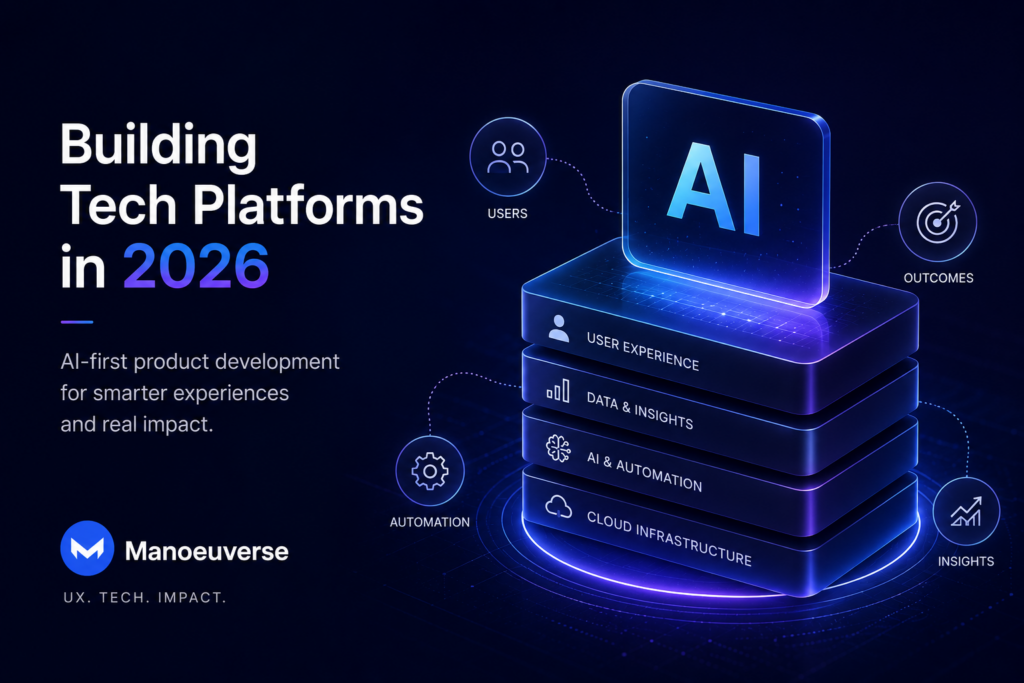
For decades, companies approached digital transformation by defining requirements, designing interfaces, building software, and launching products. While this process still exists, the emergence of Artificial Intelligence has fundamentally changed what businesses can build, how quickly they can build it, and the value they can deliver to customers.
In 2026, the question is no longer whether a company should use AI. The question is how AI should be embedded into the core of the product experience.
Organizations that continue building platforms the same way they did five years ago risk creating products that feel outdated before they even launch. Meanwhile, AI-native businesses are delivering personalized experiences, automating operations, reducing costs, and uncovering insights at a scale that was previously impossible.
At Manoeuvre, we believe the future belongs to businesses that combine user-centered design, modern technology architecture, and AI-driven intelligence from day one.
The Shift from Digital Platforms to Intelligent Platforms
Traditional platforms were designed to help users perform tasks.
AI-powered platforms are designed to help users achieve outcomes.
This distinction is important.
For example:
- A traditional healthcare platform allows patients to book appointments.
- An AI-powered healthcare platform recommends the right specialist, predicts appointment needs, summarizes medical information, and guides patients throughout their healthcare journey.
Similarly:
- A traditional e-commerce platform helps users search for products.
- An AI-powered platform understands customer intent, recommends relevant products, predicts purchasing behavior, and provides personalized assistance.
The future of digital products is not about adding AI as a feature. It is about designing intelligence into the platform itself.
Why AI Changes the Product Development Process
Historically, product teams focused on answering questions such as:
- What features should we build?
- What screens do we need?
- What workflows should users follow?
Today, product teams must also answer:
- What decisions can AI make?
- What tasks can be automated?
- What data can generate insights?
- How can AI improve user experiences over time?
This requires a different mindset.
Successful AI platforms are built through the collaboration of:
- Product Strategy
- UX Design
- Data Architecture
- AI Engineering
- Software Development
- Business Operations
Organizations that treat AI as a separate component often struggle to realize its full value.
Designing AI Around Human Needs
One of the biggest mistakes companies make is starting with technology instead of users.
The most successful AI products solve real human problems.
Before implementing AI, businesses should understand:
- User goals
- User frustrations
- Operational inefficiencies
- Business objectives
- Data availability
This is where UX plays a critical role.
AI without user-centered design often creates confusion, distrust, and poor adoption.
Users need transparency, confidence, and control when interacting with intelligent systems.
Great AI experiences feel helpful rather than intrusive.
The goal is not to replace humans.
The goal is to augment human capabilities.
The Rise of AI-Native Experiences
AI-native platforms are being built differently from the ground up.
Instead of forcing users through rigid workflows, AI adapts to users.
Examples include:
Conversational Interfaces
Users increasingly expect to interact through natural language rather than navigating complex menus.
AI assistants can:
- Answer questions
- Complete transactions
- Generate reports
- Schedule appointments
- Guide users through processes
Intelligent Recommendations
Platforms can proactively suggest actions, products, services, or content based on context and behavior.
Predictive Decision-Making
AI can identify patterns and predict future outcomes, helping businesses make faster and more informed decisions.
Automated Operations
Routine administrative work can be automated, allowing teams to focus on higher-value activities.
These capabilities create more engaging, efficient, and scalable digital experiences.
Building the Right Technology Foundation
AI is only as effective as the platform supporting it.
Businesses should focus on creating technology foundations that are:
Scalable
The platform must support growing user bases, increasing data volumes, and evolving AI capabilities.
Data-Driven
Data is the fuel powering AI systems.
Organizations should establish clear strategies for:
- Data collection
- Data quality
- Data governance
- Data security
Modular
Technology stacks should allow AI services to evolve without requiring complete system redesigns.
Secure
As AI becomes more deeply integrated into business operations, security and compliance become critical considerations.
Building AI responsibly is as important as building AI effectively.
The New Role of UX in an AI World
Many people assume AI reduces the importance of UX design.
The opposite is true.
As technology becomes more intelligent, the user experience becomes even more important.
UX teams must now design:
- Human-AI interactions
- Trust mechanisms
- AI explanations
- Personalization experiences
- Adaptive workflows
- Conversational journeys
The challenge is no longer designing screens.
The challenge is designing intelligent experiences.
This shift is transforming UX from interface design into experience orchestration.
Industries Being Transformed by AI Platforms
Nearly every industry is experiencing disruption.
Healthcare
AI-powered patient engagement, diagnostics support, appointment optimization, and care coordination.
Financial Services
Fraud detection, personalized financial advice, risk assessment, and automated customer support.
Telecommunications
Customer service automation, predictive maintenance, churn prediction, and personalized plans.
Agriculture and Plantations
Workforce management, supply chain optimization, crop monitoring, and operational forecasting.
Memorial and Legacy Services
Digital memorial platforms, family history preservation, AI-assisted storytelling, and legacy management solutions.
The common theme is simple:
Organizations are moving from digital systems to intelligent ecosystems.
What Businesses Should Do in 2026
Companies looking to build technology platforms should focus on five priorities:
1. Start with Business Outcomes
Don’t implement AI because it is trending.
Implement AI to solve meaningful business problems.
2. Invest in UX Research
Understand users before designing solutions.
Technology should support human needs.
3. Build for Data Readiness
AI success depends on clean, accessible, and structured data.
4. Create an AI Roadmap
Not every capability needs to launch on day one.
Develop a phased approach that delivers value incrementally.
5. Partner with Experts
Building AI-native platforms requires expertise across strategy, design, technology, and implementation.
Organizations that bring these disciplines together will move faster and reduce risk.
Conclusion
The future of digital products is intelligent, adaptive, and deeply personalized.
Businesses that continue treating AI as an optional feature will struggle to compete with organizations building AI-first experiences from the ground up.
Success in 2026 is not about having the most advanced technology.
It is about creating meaningful experiences where technology, design, and intelligence work together to solve real-world problems.
At Manoeuvre, we help organizations transform ideas into AI-powered digital products through strategic UX, modern technology, and human-centered innovation.
The companies that embrace this shift today will define the next generation of digital experiences tomorrow.